
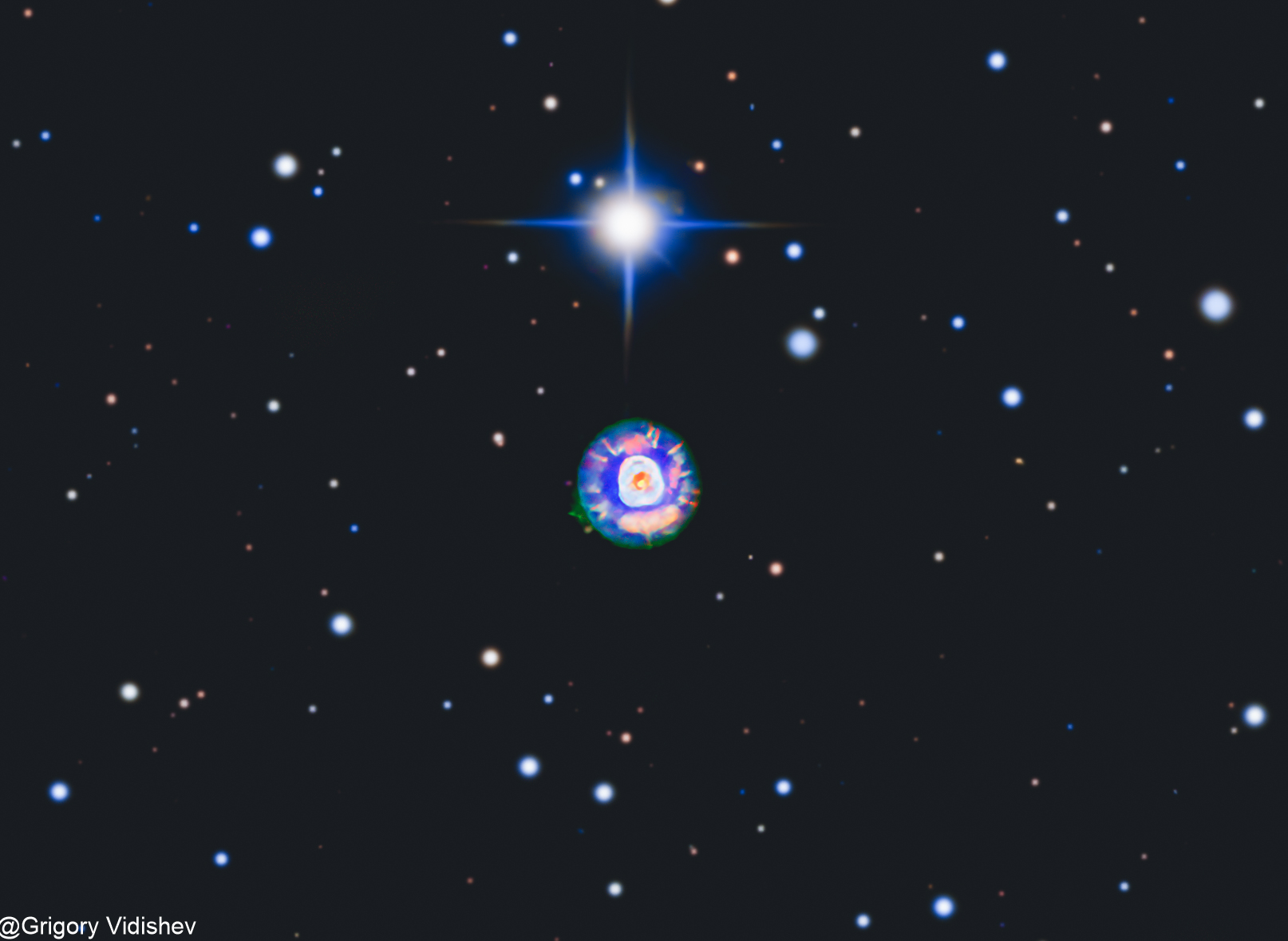
NGC 2392 Eskimo Nebula
| Description |
NGC 2392 Eskimo Nebula is small but bright object. It is difficult to process and acquire. You would need a long focus large aperture instrument. The Eskimo Nebula (NGC 2392), also known as the Clown Face Nebula, Lion Nebula, or Caldwell 39, is a bipolar double-shell planetary nebula (PN). It was discovered by astronomer William Herschel in 1787. The formation resembles a person’s head surrounded by a parka hood. It is surrounded by gas that composed the outer layers of a Sun-like star. The visible inner filaments are ejected by a strong wind of particles from the central star. The outer disk contains unusual, light-year-long filaments. NGC 2392 lies about 6500 light-years away, and is visible with a small telescope in the constellation of Gemini. At the center of NGC 2392, there is an O-type star (designated HD 59088[7]) with a spectral type of O(H)6f.
|
|---|---|
| Data/Processing Attribution |
This is my data and processing. |
| Distances/Size |
Distance to the object: 6,520 light-years, size in the sky 48” X 48″ |
| Equipment |
Mount-PlaneWave L-350; Scope-PlaneWave CDK14″, 356 mm aperture, 2563 mm focal length; Camera-Moravian C3-61000, 0.30 arcsec/pixel. |
| Observatory |
The image was taken in the Prairies Skies Astro remote observatories. |
| Exposure |
The total exposure using SHORGB filters is 21 hours and 15 minutes 30 secons, with each sub-exposure lasting 300 and 90 seconds. This is the processing of the data taken in December 2025 and January 2026. SHORGB Filters for stars Ha- 96X300 and 90= 3 hours 48 minutes O3- 96X300 and 90= 3 hours 48 minutes S2- 85X300 and 90= 2 hours 53 minutes R- 144X90= 3 hours 34 minutes 30 sec G-144X90= 3 hours 36 minutes B-148X90= 3 hours 36 minutes Processing is done in PixInsight, Photoshop, and Lightroom Classic |