
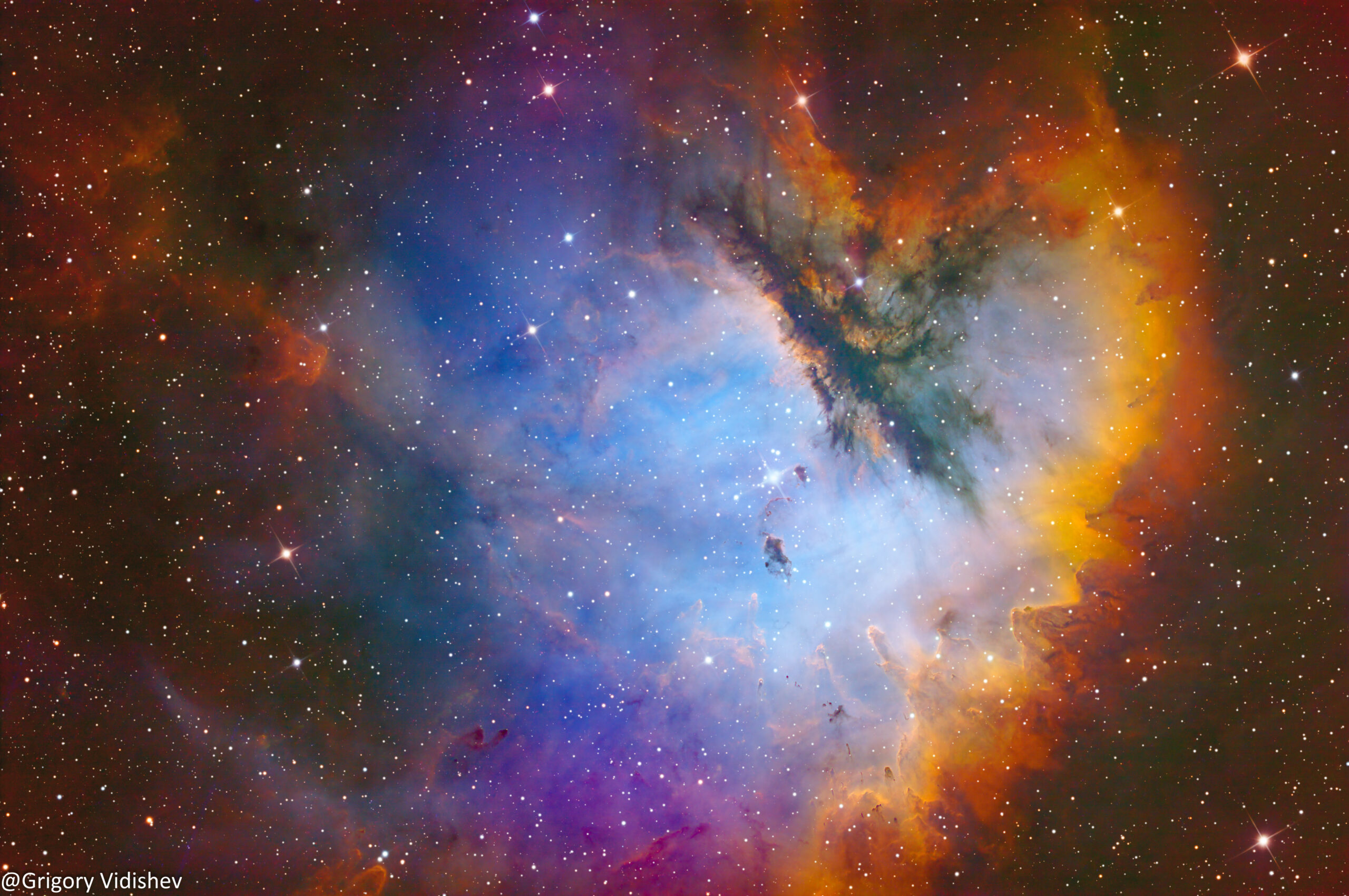
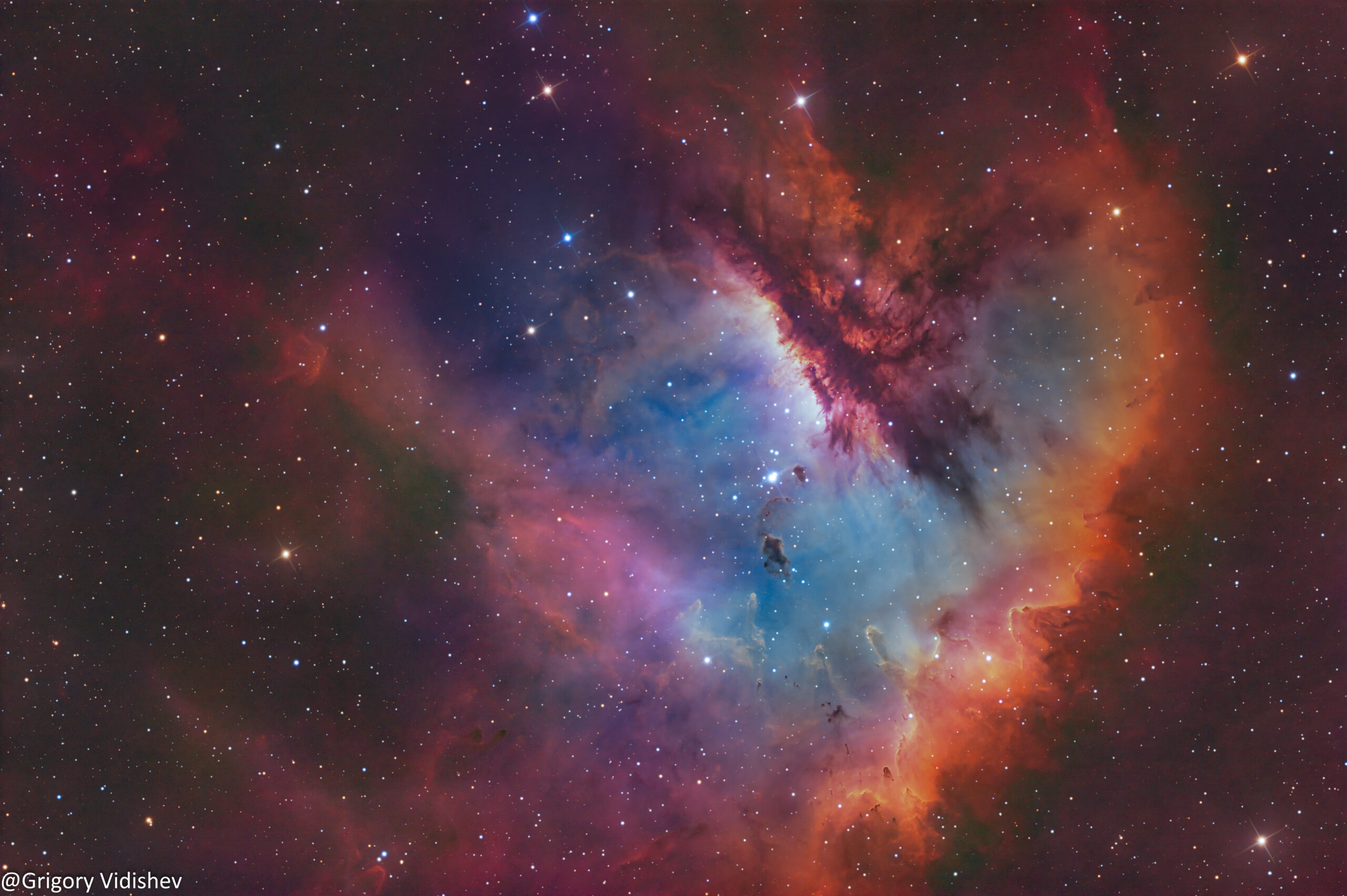
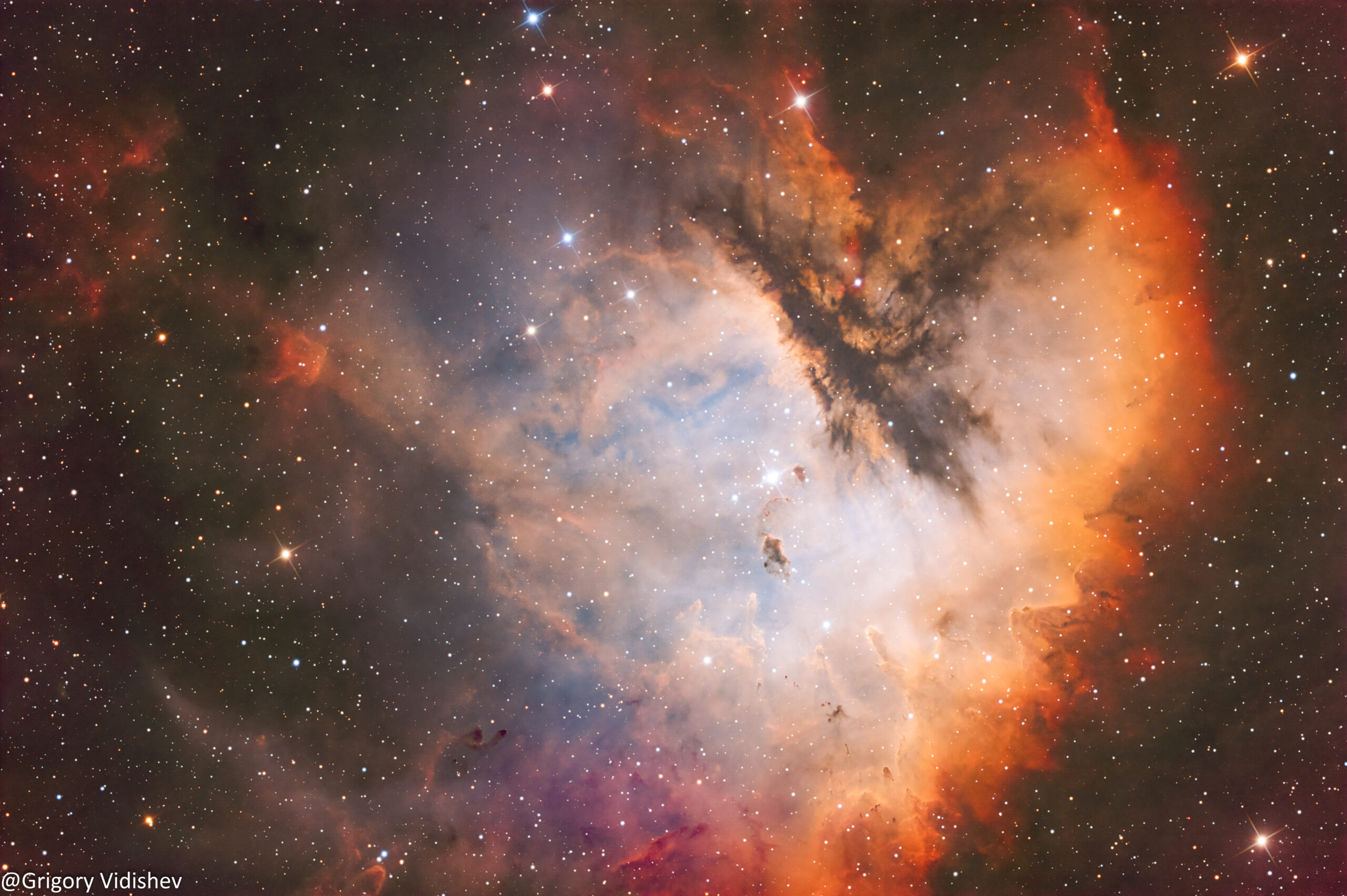
NGC281 Pacman Nebula November 2025
| Description |
IC 11, also known as Sh2-184 or the Pacman Nebula due to its resemblance to the video game character, is a bright emission nebula that is part of an H II region in the northern constellation of Cassiopeia. It lies within the Perseus Spiral Arm of the Milky Way. This nebula has a size of 20×30 arcminutes and is associated with the open cluster IC 1590, several Bok globules, and the multiple star system B 1. Collectively, they form Sh2-184, which spans a larger area of 40 arcminutes. The Pacman Nebula was discovered by Edward Emerson Barnard in August 1883, who described it as “a large faint nebula, very diffuse.” The multiple star system B 1, also referred to as β 1, was later identified by S. W. Burnham, with its bright component being the highly luminous O6 spectral class star HD 5005. This system consists of an 8th-magnitude primary star accompanied by four companions situated at distances ranging from 1.4 to 15.7 arcseconds. Notably, there has been no significant change in this quintuple system since observations began in 1875. The nebula can be viewed with amateur telescopes from dark sky locations. In his book “Deep Sky Wonders,” Walter Scott Houston describes the appearance of the nebula when viewed through small telescopes, noting, “There was a faint glow in the immediate vicinity of the multiple star, with an occasional impression of a much larger nebulosity… Its surface brightness was much less than that of M33 in Triangulum or NGC 205, the distant companion of the Andromeda galaxy.”h larger nebulosity… Its surface brightness was much less than that of M33 in Triangulum or NGC 205, the distant companion of the Andromeda galaxy.” |
|---|---|
| Data/Processing Attribution |
This is my data and processing. |
| Distances/Size |
Distance to the object- 9,200 light years; angular size in the sky is about 35’ (minutes); size of the nebula is about 48 light years in diameter. |
| Equipment |
Mount-PlaneWave L-350; Scope-PlaneWave CDK14″, 356 mm aperture, 2563 mm focal length; Camera-Moravian C3-61000, 0.30 arcsec/pixel. |
| Observatory |
The image was captured at the Prairie Skies Astro remote observatory. |
| Exposure |
The total exposure using SHO and RGB filters is 39 hours, 29 minutes, and 2 seconds, with each SHO sub-exposure lasting 600 seconds and RGB lasting 90 seconds. SH0 Filters H- 66X600= 11 hours 0 minutes 0- 62X600= 10 hours 20 minutes S- 59X600= 9 hours 50 minutes RGB Filters R- 115X90= 2 hours 52 minutes 30 seconds G-101X90= 2 hours 31 minutes 30 seconds B-118X89= 2 hours 55 minutes 2 seconds Total- 39 hours 29 minutes 2 seconds Processing is done in PixInsight, Photoshop, and Lightroom Classic |