
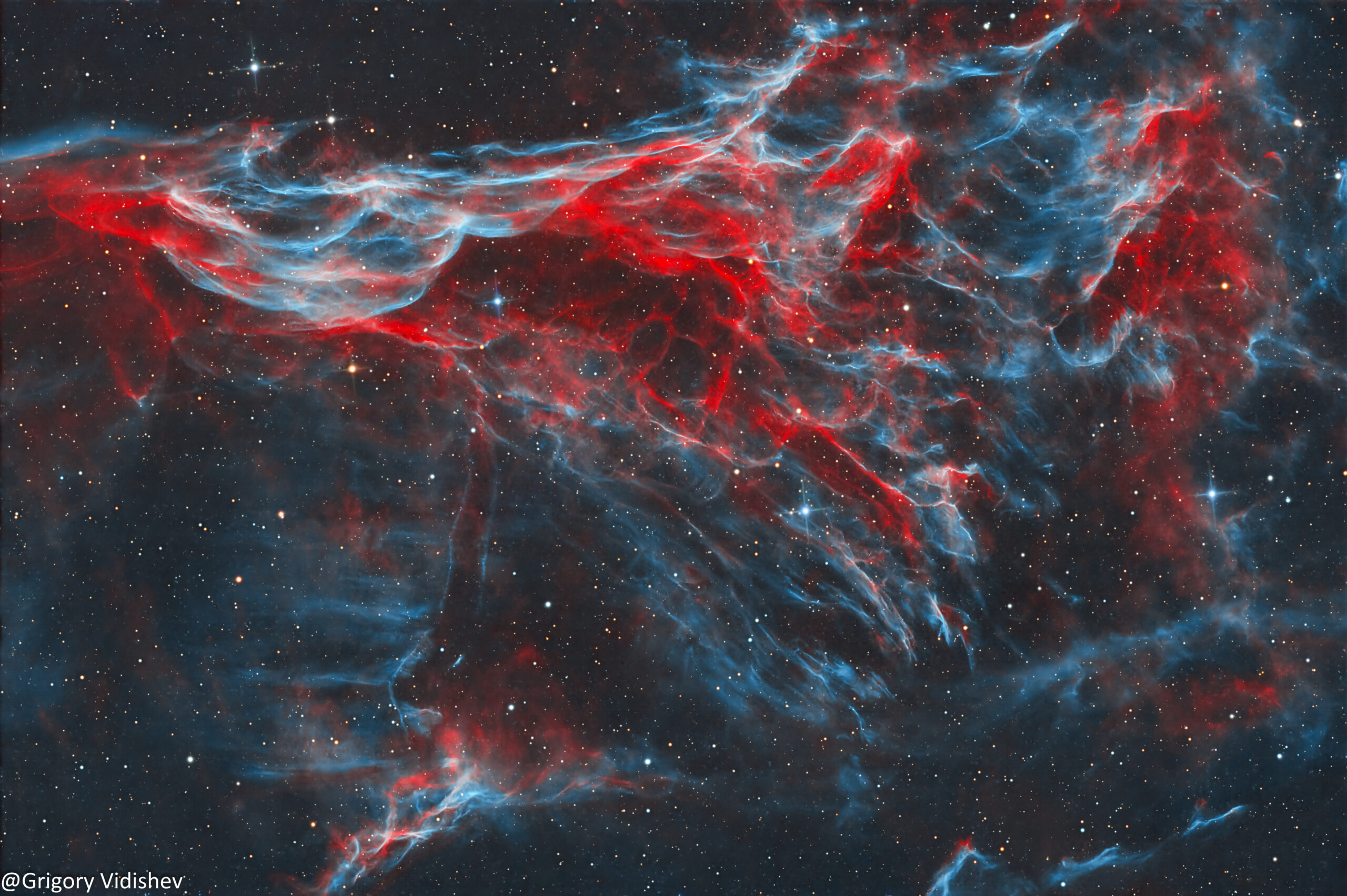

NGC6960- Pickering Triangle
| Description |
The Pickering Triangle is part of the Veil Nebula, is a cloud of heated and ionized gas and dust in the constellation Cygnus. It constitutes the brightest parts of the visible portion of the Cygnus Loop, a supernova remnant, many portions of which have acquired their own individual names and catalogue identifiers. The source supernova was a star 20 times more massive than the Sun, which exploded between 10,000 and 20,000 years ago. At the time of the explosion, the supernova would have appeared brighter than Venus in the sky and visible in the daytime. The remnants have since expanded to cover an area of the sky roughly 3 degrees in diameter (about 6 times the diameter, and 36 times the area, of the full moon). While previous distance estimates have ranged from 1,200 to 5,800 light–years, a 2018 determination of 2,400 light-years is based on direct astrometric measurements. (The distance estimates also affect the estimates of size and age.) Pickering’s Triangle (or Pickering’s Triangular Wisp), brightest at the north central edge of the loop but visible in photographs continuing toward the central area of the loop. |
|---|---|
| Data/Processing Attribution |
This is my data and processing. |
| Distances/Size |
Distance to the object: 2,400 light-years. |
| Equipment |
Mount-PlaneWave L-350; Scope-PlaneWave CDK14″, 356 mm aperture, 2563 mm focal length; Camera-Moravian C3-61000, 0.30 arcsec/pixel. |
| Observatory |
The image was captured at the Prairie Skies Astro remote observatory. |
| Exposure |
The total exposure using SHO filters is 9 hours, 21 minutes, and 24 seconds, for a total of 300 seconds. RGB shots are done for stars only. SHO and RGB Filters Ha-32X300= 2 hours 40 minutes O3-24X300= 2 hours 0 minutes S2-24X300 2 hours 0 minutes R-36X90= 0 hours 54 minutes G-36X90= 0 hours 54 minutes B-36X89= 0 hours 53 minutes 24 sec Total- 9 hours 21 minutes 24 sec Processing is done in PixInsight, Photoshop, and Lightroom Classic |